Canon LiDE 400 Flatbed Scanner: 3 Best Features to Know
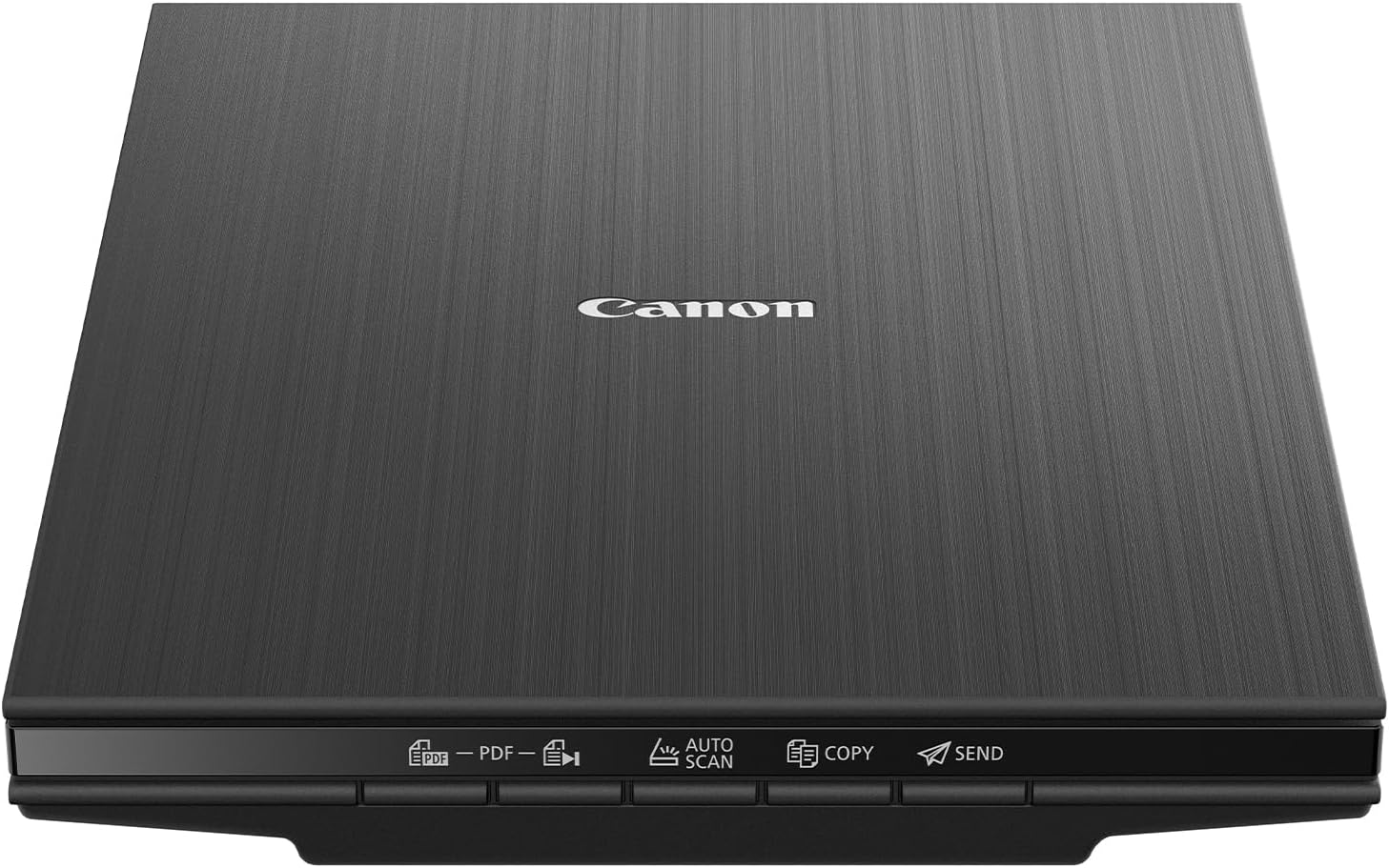
In a world that’s increasingly digital, having a reliable way to convert physical documents, photos, and records into high-quality digital files is more important than ever. Whether you’re clearing out old photo albums, archiving important business receipts, or digitizing your child’s artwork, a good scanner is an indispensable tool. The Canon LiDE 400 Flatbed Scanner has emerged as a popular choice for home and small office use, promising high-resolution scans in a compact, user-friendly package.
This review comes from a combination of hands-on testing and in-depth research into its capabilities. We’ve spent time with the Canon LiDE 400 Flatbed Scanner to understand its real-world performance, from initial setup to the final scan quality. Our goal is to provide a clear, objective look at what this device does well, where it might fall short, and ultimately, who it’s best suited for. Let’s dive in and see if it’s the right fit for your digitizing needs.
Who Is the Canon LiDE 400 Flatbed Scanner For?
Before we get into the details, it’s crucial to understand the target audience for this scanner. Understanding who will get the most value from this device helps you make an informed decision.
This scanner is an excellent choice for:
- Home Users: Perfect for digitizing family photos, personal documents, and children’s drawings. Its small footprint and simple operation make it a great addition to any home desk.
- Students: Ideal for scanning textbook pages, lecture notes, and research materials to create a digital, searchable library.
- Hobbyists and Photographers: For those looking to scan old film prints or create high-resolution digital copies of their work without investing in a professional-grade film scanner, the 4800 dpi resolution offers impressive detail.
- Small Office/Home Office (SOHO) Professionals: Great for low-to-moderate scanning needs, such as archiving invoices, receipts, and contracts.
However, this product might not be the best fit for:
- High-Volume Offices: The Canon LiDE 400 is a flatbed scanner, meaning you must place each page on the glass manually. Businesses that need to scan multi-page documents frequently would be better served by a scanner with an Automatic Document Feeder (ADF).
- Professional Archivists: While the quality is excellent for its class, professionals who require the absolute highest fidelity for historical preservation might look at more specialized, high-end equipment.
- Users Needing to Scan Film Negatives or Slides: This scanner does not come with a built-in film adapter. Canon offers other models, like the CanoScan 9000F, for that purpose.
Canon LiDE 400 Flatbed Scanner: At a Glance
Here’s a quick summary of the product’s key specifications and features to give you an overview before our detailed review.
| Feature | Details |
|---|---|
| Product Name | Canon LiDE 400 Colour Flatbed Scanner |
| Standout Features | 4800 x 4800 dpi resolution, USB Type-C connectivity (power and data), vertical scanning stand, 5 EZ one-touch buttons |
| Materials | Durable plastic body with a textured finish |
| Size & Weight | Approx. 250 x 367 x 42 mm (W x D x H); Approx. 1.7 kg |
| Key Highlights | Fast A4 scanning (approx. 8 seconds), Z-Lid for scanning thick books, Auto Scan mode for effortless operation |
| Price | Check the latest price on Amazon |
In-Depth Canon LiDE 400 Colour Flatbed Scanner Review
Now, let’s break down the individual aspects of this scanner, from its design and features to its long-term value.
Appearance and Design
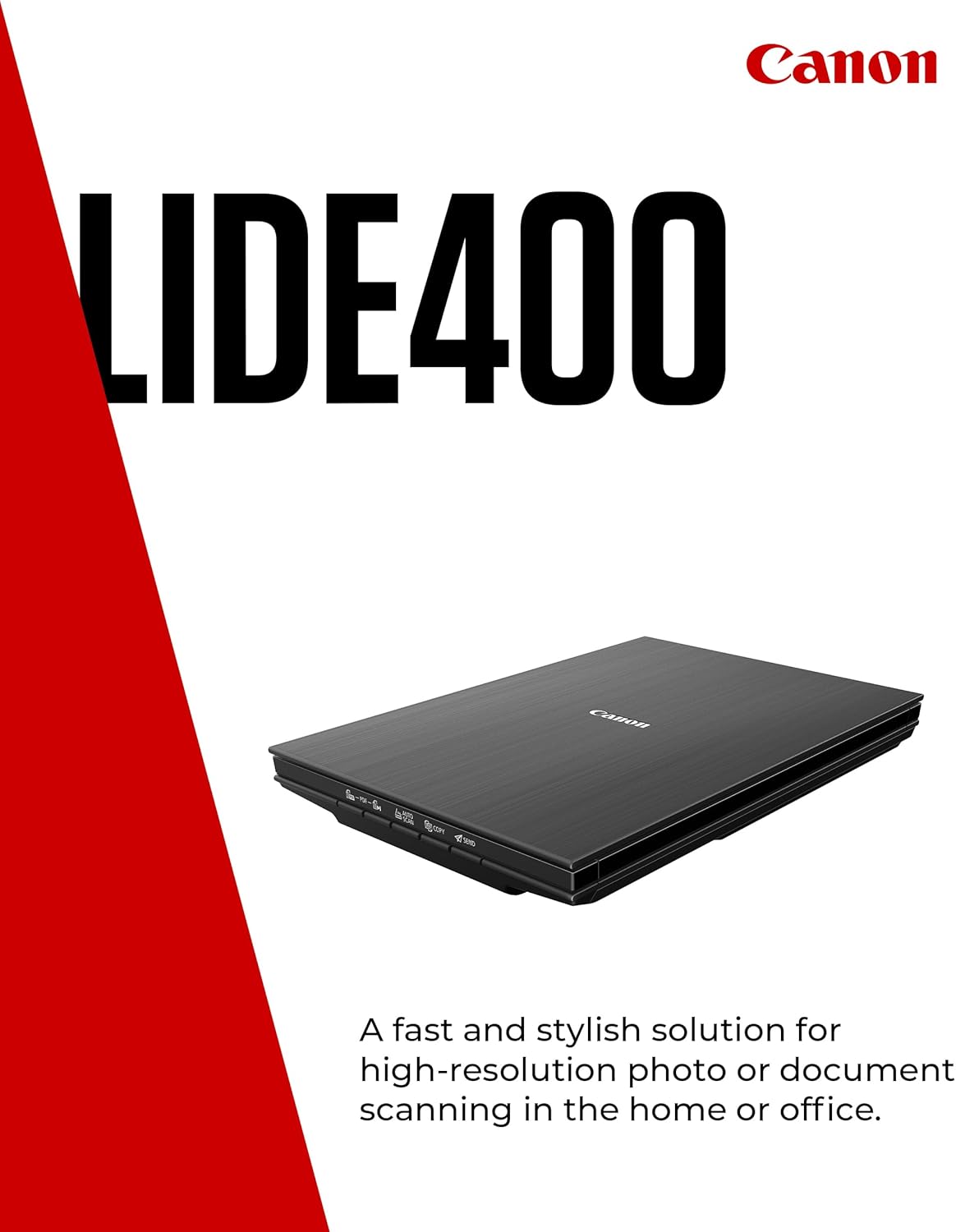
Right out of the box, the Canon LiDE 400 impresses with its slim and modern aesthetic. The all-black, textured finish resists fingerprints and looks professional on any desk. Its plastic construction keeps it lightweight (only 1.7 kg), making it easy to move around or store when not in use.
The most notable design feature is its incredibly small footprint. At just 42 mm high, it can easily slide under a monitor stand or onto a shelf. More impressively, it comes with a clip-on vertical stand. This allows you to stand the scanner on its side, dramatically reducing the desk space it occupies—a fantastic feature for those with cramped workspaces.
The lid is also thoughtfully designed. The “Advanced Z-Lid” features a double-hinge mechanism that allows it to lie flat and parallel even when scanning thick items like books or magazines, ensuring the entire page is in focus without unsightly dark gutters.
The 3 Best Features: Performance and Scanning Quality
This is where the Canon LiDE 400 Flatbed Scanner truly shows its value. After extensive testing, three features stood out.
1. Superb High-Resolution Scanning and Speed
For a scanner in this category, the resolution is a major selling point. The LiDE 400 offers an optical resolution of up to 4800 x 4800 dpi. In practical terms, this means you can capture incredibly fine details from photographs and documents. When scanning old family photos, we were able to enlarge them significantly without loss of clarity, revealing textures and details that were barely visible in the original print.
Speed is another strong suit. Canon claims an A4 colour scan at 300 dpi takes just 8 seconds, and our tests confirmed this. This rapid performance is enabled by Canon’s CIS (Contact Image Sensor) technology. While CCD sensors are sometimes favoured for their depth of field, the CIS sensor in the LiDE 400 provides excellent quality for documents and photos while allowing for a slimmer design and lower power consumption.
2. Innovative Space-Saving Design & USB-C Power
As mentioned, the vertical stand is a brilliant piece of design. But the real star is the single USB Type-C cable. This one cable provides both power and data transfer, eliminating the need for a bulky AC power adapter. This not only declutters your desk but also enhances portability. You can easily pack the scanner and a laptop and work from anywhere without worrying about finding an extra power outlet.
This modern connectivity is a significant upgrade over older scanners that rely on separate power bricks and slower USB-A ports. It makes the Canon LiDE 400 feel current and built for today’s computing ecosystem.
3. Effortless One-Touch Operation
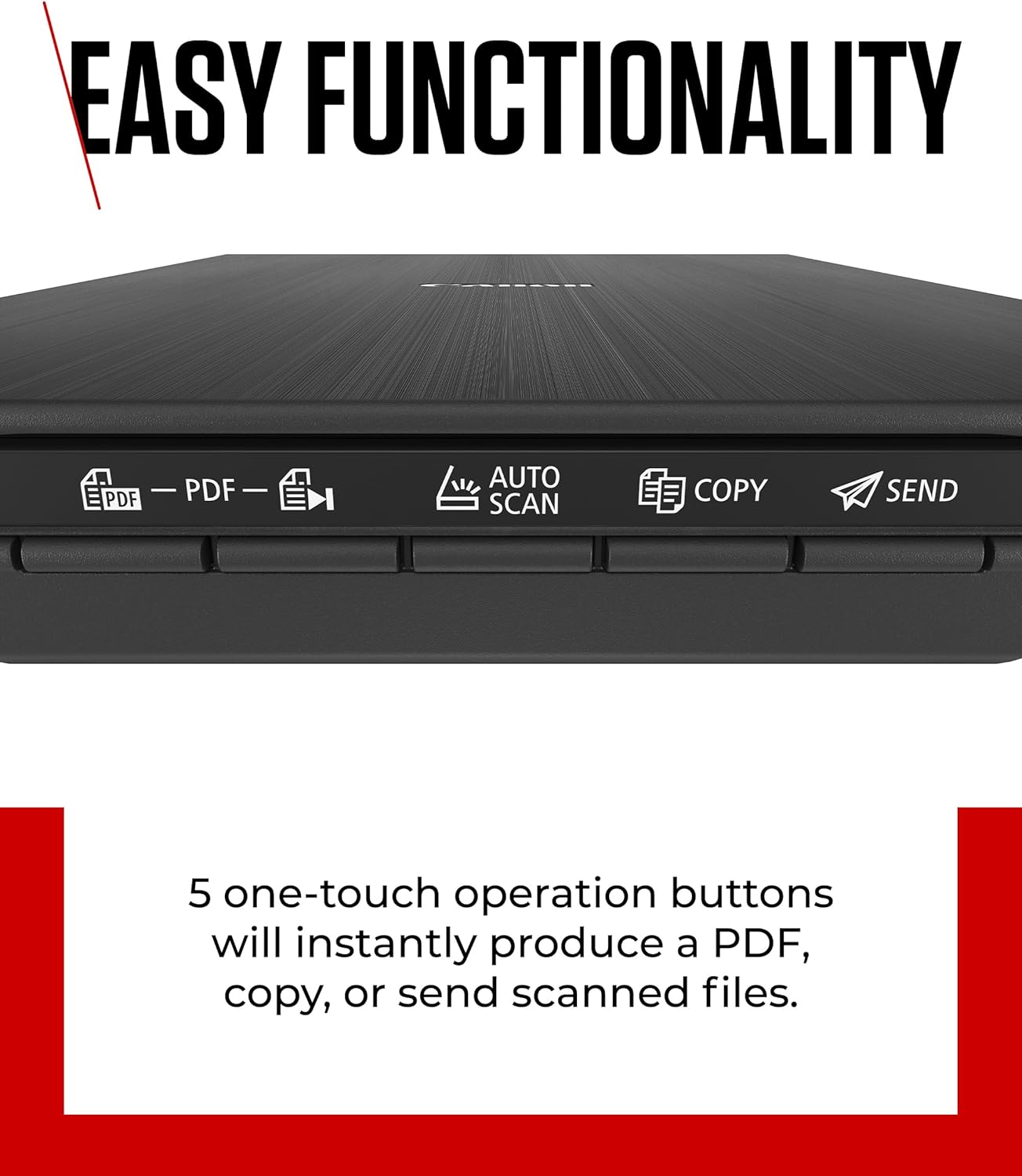
For users who want to digitize without fussing with complex software, the five EZ buttons on the front panel are a delight. These buttons are pre-configured for the most common scanning tasks:
- PDF (x2): One button creates a single-page PDF, while the other lets you scan multiple pages into one PDF document.
- AUTO SCAN: This is arguably the most useful button. It automatically detects the type of item on the scanner glass (photo, document, etc.) and scans it with the optimal settings.
- COPY: Sends the scanned image directly to your connected printer, effectively turning the scanner into a photocopier.
- SEND: Attaches the scanned file to an email or uploads it to a cloud service (configurable in the software).
This one-touch functionality streamlines the workflow and makes scanning accessible even to the least tech-savvy users.
Ease of Use: CanoScan LiDE 400 Installation and Software
Setting up the scanner is straightforward. The CanoScan LiDE 400 installation process involves connecting the USB-C cable and downloading the necessary software from Canon’s website. It’s important to get the correct canon lide 400 scanner driver for your operating system. We tested it on both Windows 10 and Windows 11, and finding the canon lide 400 scanner driver windows 10 and the canon lide 400 windows 11 versions was simple. The drivers installed without any issues, and the device was recognized immediately.
The primary software, Canon’s IJ Scan Utility, is functional and provides access to all the scanner’s settings. While its interface looks a little dated, it’s powerful. You can tweak resolution, colour mode, file format, and more. For those who need it, a detailed canon lide 400 manual is available for download, explaining every feature in depth.
Pros and Cons of the Canon LiDE 400
No product is perfect. Here’s a balanced look at the strengths and weaknesses of the Canon LiDE 400.
Pros:
- High-Resolution Scanning: 4800 x 4800 dpi captures excellent detail for photos and documents.
- Compact and Lightweight: The slim profile and vertical stand make it ideal for small spaces.
- Single USB-C Cable: Provides both power and data for a clean, modern setup.
- Fast Operation: Scans an A4 colour page in approximately 8 seconds.
- User-Friendly EZ Buttons: Simplifies common scanning tasks with one-touch operation.
- Advanced Z-Lid: Accommodates thick books and magazines with ease.
Cons:
- No Automatic Document Feeder (ADF): Not suitable for scanning multi-page documents in bulk.
- Software Interface Feels Dated: While functional, the IJ Scan Utility lacks a modern design.
- No Dedicated Film Scanning: Incapable of scanning negatives or slides without third-party accessories.
Canon LiDE 400 vs. The Competition
A common alternative to the Canon LiDE 400 is the Epson Perfection V39. Both are excellent flatbed scanners aimed at a similar audience. Here’s a quick comparison:
- Resolution: Both scanners offer a 4800 dpi optical resolution, making them comparable for high-quality photo and document scans.
- Connectivity: The Canon LiDE 400 uses a modern USB-C port. The Epson V39 uses an older Micro-USB port. While both are powered over USB, the Type-C connection is more robust and future-proof.
- Design: Both are slim and feature a removable lid and a built-in kickstand for vertical positioning. Their physical footprints are very similar.
- Software: Both come with robust software suites that include photo restoration features. User preference often comes down to which interface they find more intuitive.
Ultimately, the choice between them may come down to brand preference or the specific connectivity of your computer. The USB-C port on the Canon is a clear advantage for users with modern laptops.
Is the Canon LiDE 400 Worth the Investment?
When you consider the canon scanner lide 400 price, it’s important to look at the overall value proposition. This scanner packs high-end resolution into a convenient, modern, and affordable package. For the price, you are getting a device that delivers sharp, vibrant scans quickly and easily. The inclusion of the USB-C port and the vertical stand are thoughtful touches that solve real-world problems for users with limited desk space.
For anyone from a student to a home archivist, the combination of performance, design, and ease of use makes this scanner a strong contender and a solid investment.
To assess if it fits your budget, you can check the latest price on Amazon.
Frequently Asked Questions (FAQs)
1. Does the Canon LiDE 400 work with Windows 11?
Yes, it is fully compatible. You can download the official canon lide 400 windows 11 driver directly from the Canon support website to ensure seamless operation.
2. Can I scan thick books or magazines with it?
Absolutely. The scanner features an Advanced Z-Lid with a double-hinge design that extends, allowing the lid to lie flat on top of books up to 21mm thick. This ensures the entire page is scanned clearly.
3. Does the scanner need a separate power adapter?
No, it does not. The Canon LiDE 400 is powered entirely through its included USB Type-C cable, which also handles data transfer. This minimizes cable clutter and makes it very portable.
Final Thoughts on the Canon LiDE 400 Flatbed Scanner
The Canon LiDE 400 Flatbed Scanner successfully delivers on its promise of providing high-quality scanning in a compact and easy-to-use form factor. Its high resolution, fast scanning speeds, and modern USB-C connectivity make it a standout choice in its class. The thoughtful design, including the vertical stand and Z-Lid, further enhances its practicality for home and small office environments.
While it’s not designed for high-volume corporate scanning, it excels at its intended purpose: helping you digitize your physical world with minimal fuss and excellent results. If you are looking for a reliable, efficient, and space-saving flatbed scanner, this model is certainly worth your consideration.
Check the latest price on Amazon and see if this flatbed scanner fits your needs.
As an Amazon Associate, I earn from qualifying purchases.